

By HFI staff
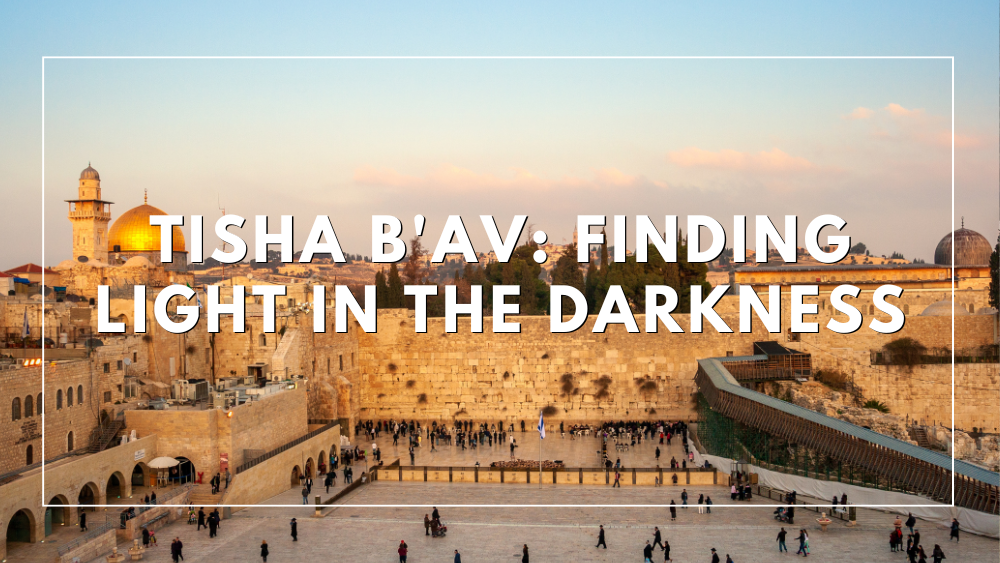
Tisha B'Av, the ninth day of the Hebrew month of Av, is the saddest day on the Hebrew calendar. This year the commemoration falls on July 23. Throughout the history of our people, many tragedies have occurred on this day. Most notably, both the First and Second Temples were destroyed in Jerusalem. Additionally, Tisha B'Av has become associated with other great tragedies in Jewish history, including the expulsions of the Jewish people from England and Spain.
The Book of Lamentations is read, which begins with the mournful cry, "Eicha!" "How?" How could this happen? Yet beneath this sorrow lies a profound spiritual lesson. Tisha B'Av is not merely about remembering what happened and what was lost. It is about understanding why it was lost, what can be salvaged from that loss, and how each of us is responsible, in our own way, to participate in the work of rebuilding.
The prophets taught that although foreign armies destroyed the Temple, the deeper cause of its destruction was the spiritual condition of the nation. The First Temple fell during a time marked by idolatry, immorality, and bloodshed. The Second Temple, according to the Sages, was destroyed because of baseless hatred. The enemies who came against Jerusalem were real, but the prophets continually called God's people to examine the condition of their own hearts. This teaching is especially striking because the people remained religious in many outward ways, yet divisions and jealousy weakened the nation from within.
I cannot help but wonder whether the similarities to the current situation in Israel are becoming increasingly evident. When I read the prophets, I sometimes feel as though I am reading the evening news. I see a nation facing external threats while also wrestling with internal divisions, questions of leadership, and the need to return to God. Although the circumstances are different, the spiritual lessons remain remarkably familiar.
The lessons remain timeless. The prophets repeatedly called God's people not to focus only on the enemies outside their gates, but also on the condition of their own hearts. Pride, injustice, and divisions within the nation weakened the very foundations God desired to build. We must take heed that we do not fall into the temptation of thinking that we are independent of one another or, God forbid, of our Maker.
"How has this happened?" is a fundamental question for us to ask and answer honestly, both individually and corporately. The need to remain open to correction must mark our walk with one another and with God. Yet Tisha B'Av, far from being only a day of mourning, contains within it the seeds of hope. Our history reflects this truth. After the destruction of the First Temple, prayer and Torah study became central expressions of Jewish life. After the destruction of the Second Temple and the subsequent exile, Jewish life continued and flourished throughout the diaspora. Again and again, what appeared to be an ending became the beginning of a new chapter. God's presence continued to accompany His people wherever they went.
While reading the Book of Lamentations, amid all the descriptions of suffering, a remarkable declaration emerges. In Lamentations 3:22-23 we read:
"Because of the LORD's lovingkindness we are not consumed, for His compassions never fail. They are new every morning; great is Your faithfulness."
It is almost as if, in the midst of destruction, despair, and God's righteous judgment, He whispers a word of hope. That hope is not found in our own strength or even in our resilience. Rather, it is found in His goodness, His grace, and His unfailing faithfulness, even when we have reached the depths of despair.
In the midst of unimaginable suffering lies the hope found in the goodness of God.
This changes the way we think about suffering. We are never asked to pretend that pain is not real. There are tragedies that defy explanation. Yet even in those moments, faith, repentance, and perseverance can emerge. The fulfillment of God's purposes may belong to future generations, and we may never see the complete fruit during our lifetime. Nevertheless, we live with confidence because God has promised His people "a future and a hope."
As the fast ends, mourning gives way to comfort. The following Shabbat is known as Shabbat Nachamu, the Sabbath of Comfort. It begins with the beautiful words of Isaiah:
"Comfort, comfort My people."
Sorrow does not have the final word. Even in the midst of destruction comes God's promise of renewal.
Tisha B'Av reminds us that every generation is given an opportunity to rebuild. We must choose hope over despair. Every prayer, every act of kindness, and every expression of genuine love reflects the hope of the redemption God has promised.
It is impossible to read these words without thinking, in some measure, of the daily news. Israeli society is experiencing one of the most challenging periods in its modern history. The war that began on October 7 has placed extraordinary demands upon our nation, while long-standing disagreements over identity, responsibility, religion, government, the judicial system, and military service have become increasingly pronounced. These debates continue to shape Israeli society and are likely to become even more pronounced in the months ahead.
Tisha B'Av reminds us that even when disagreements are real, we must guard against allowing them to become divisions that weaken us from within. At a time when Israel continues to face enemies committed to her destruction, preserving our unity without demanding uniformity is more important than ever.
Though we are a resilient people, we are also a damaged and traumatized people. The breach of our borders on October 7, 2023, has left many of us scarred and changed. Yet I have also witnessed remarkable courage, compassion, and hope throughout Israel. Despite our disagreements, we have begun to rebuild. Communities in the Western Negev are slowly coming back to life, reminding us that even after great tragedy, hope can take root once again.
We need revival on every front: physically, emotionally, personally, corporately, and spiritually. Please pray for our people. Pray for a nation that has been battered and broken, yet continues to hope. Pray that our people would experience the compassion of God and the comfort that only He can give.
"Comfort, comfort My people." May we not only hear those words, but also become instruments through which God brings His comfort to others.