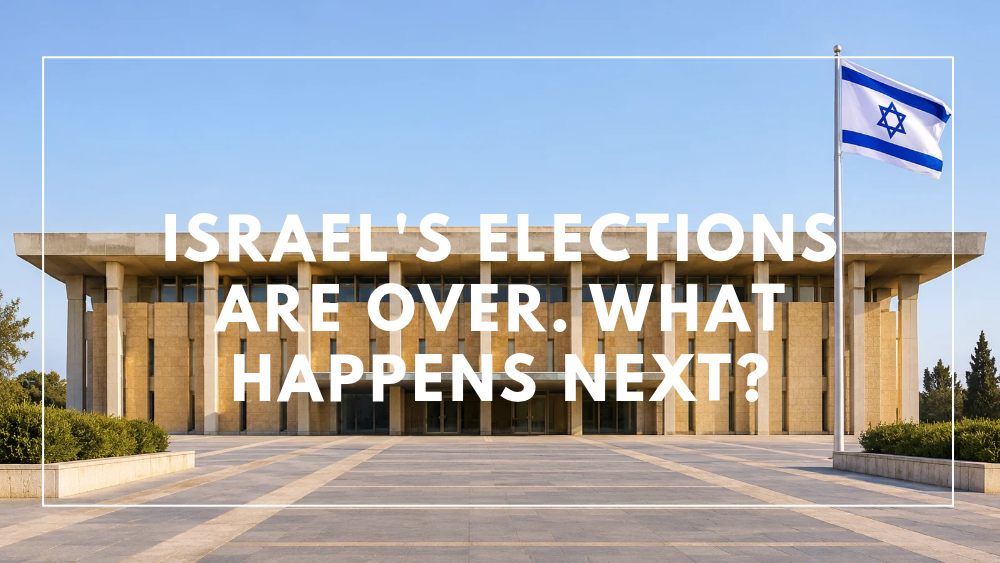
Israel held its national elections on October 27, 2026, with nearly 78 percent of eligible voters participating. However, the results did not produce a clear parliamentary majority, leaving our country facing the difficult task of forming its next government.
Unlike the United States, where voters elect a president, in Israel we vote for political parties rather than directly choosing a prime minister. The number of votes each party receives determines its representation in the Knesset, Israel's parliament, which consists of 120 members. To form a government with a parliamentary majority, a coalition generally needs the support of at least 61 members. Because Israel has many political parties representing different political, religious, and social interests, forming a government often requires difficult negotiations and compromises.
In the recent elections, the bloc associated with Prime Minister Benjamin Netanyahu secured 53 seats, while the bloc led by former Israel Defense Forces Chief of Staff Gadi Eisenkot received 48. The Arab parties won a combined 19 seats. Neither of the two leading blocs secured the majority needed to govern independently.
Following the elections, President Isaac Herzog began consultations with representatives of the political parties elected to the Knesset. During these consultations, parties representing 67 members recommended Eisenkot to receive the mandate to form a government, while 46 recommended Netanyahu. The remaining seven members, representing United Torah Judaism, did not recommend either candidate.
It is important to understand that recommending someone to receive the mandate does not necessarily mean agreeing to participate in that person's government. Two Arab parties supported Eisenkot's nomination, but their recommendations do not automatically translate into participation in a governing coalition.
On Sunday, November 8, President Herzog officially entrusted Eisenkot with the responsibility of forming Israel's next government. Under Israeli law, he has 28 days to accomplish this task, with the possibility of receiving an additional 14 days if necessary. If he is unsuccessful, the President may give another Knesset member the opportunity to form a government. Additional procedures are available before another election becomes necessary.
The newly elected Knesset was sworn in on November 10, but the political negotiations are far from over. Netanyahu continues serving as prime minister until a new government is formed and approved by the Knesset.
One possibility being discussed is the formation of a broad national unity government, bringing together parties that would not ordinarily cooperate. Another possibility involves a narrower coalition or even a minority government that could survive with sufficient parliamentary support. Each option presents significant political challenges, particularly because some parties have ruled out working with others.
Beyond the political negotiations, Israel faces serious issues that will affect our country's future for years to come.
National security remains one of our greatest concerns. The consequences of the October 7, 2023, terrorist attacks by Hamas continue to affect our nation, and many families are still living with the pain of losing loved ones. We also need answers regarding the failures that allowed those attacks to happen and accountability for those responsible.
Another major issue is military service, particularly the ongoing debate over exemptions for ultra-Orthodox men. In a country where military service is mandatory for most Jewish Israeli citizens, and where our soldiers and their families have carried an enormous burden during the war, this issue has become increasingly difficult to resolve.
There are also disagreements concerning the relationship between the government and the judiciary, the role of religion in public life, the rising cost of living, and the challenges facing Israel's Arab citizens. These are not simply political arguments. They affect our daily lives, our families, our economy, and the kind of country we are leaving for the next generation.
As Israelis, we must recognize that our nation cannot afford to remain trapped in endless political disagreements. We do not all share the same political views, and we certainly do not agree on every issue. However, the security of our country, the well-being of its citizens, and the responsibility we have toward future generations must remain priorities.
The challenge facing our elected leaders is not simply to secure enough seats to form a government. It is to establish a government capable of making difficult decisions, addressing the divisions within our society, and leading Israel responsibly during a particularly challenging period.
Another election remains a possibility if efforts to form a government fail. However, another election would place additional financial and political burdens on a country already facing significant challenges.
As Israel enters this important period, we encourage you to continue praying for our nation. Pray that God will grant our leaders wisdom and discernment, guide the process of forming a new government, and bring greater unity and healing to our society. May those entrusted with leading Israel make decisions that will protect our country, serve the well-being of all its citizens, and secure a better future for the generations to come.