

By Karen Kruger
How did a nation smaller than the state of New Jersey, with limited natural resources and facing extraordinary security challenges throughout its modern history, become one of the world’s leading centers of innovation?
That question has fascinated economists, entrepreneurs, and world leaders for decades. In 2009, Dan Senor and Saul Singer helped give this phenomenon a name with their bestselling book, Start-Up Nation: The Story of Israel’s Economic Miracle. They explored how a relatively small country had produced an extraordinary number of start-up companies, technological breakthroughs, and successful entrepreneurs.
More than fifteen years later, the question remains just as interesting. Israel continues to face significant security, political, and economic challenges, yet it also continues to produce technologies and ideas that affect the lives of people throughout the world.
What is it about this tiny nation that continually turns limitations into possibilities?
When the modern State of Israel was established, the country faced enormous challenges. Water was scarce, relatively little of the land was suitable for agriculture, and the young nation possessed few natural resources. At the same time, large numbers of Jewish immigrants were arriving from countries throughout the world. Israel had to build communities, establish infrastructure, develop agriculture, absorb immigrants, create an economy, and defend itself.
These challenges demanded solutions.
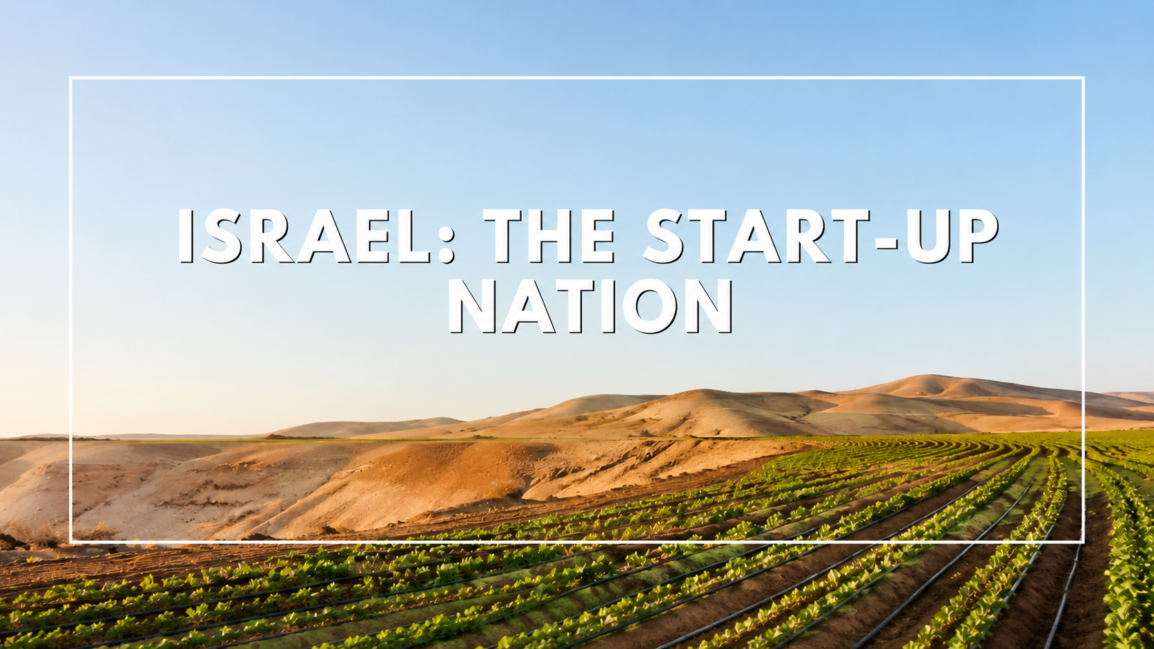
Water is one of the clearest examples. Israeli engineer Simcha Blass played a central role in developing modern drip irrigation, which delivers water directly to the roots of plants rather than flooding entire fields. Israel later became a leader in desalination, wastewater recycling, and other water technologies. Today, Israel recycles approximately 90 percent of its wastewater, primarily for agricultural and other uses. Solutions developed to address problems at home have helped communities facing water scarcity in other parts of the world.
This pattern has repeated itself throughout Israel’s modern history. When a problem appears, Israelis begin asking whether there might be a better way to solve it. That willingness to ask questions is an important part of understanding how Israel became the Start-Up Nation.
Israel’s greatest resource has never been something found beneath the ground. It has always been its people.
Education has played an important role in developing that resource. Israeli schools and universities have placed significant emphasis on science, mathematics, medicine, engineering, and technology. World-class institutions such as the Technion – Israel Institute of Technology and the Weizmann Institute of Science have produced scientists, engineers, physicians, and researchers whose work has had an impact far beyond Israel.
However, education alone does not explain Israel’s success. Israeli culture itself encourages people to ask questions. Israelis are famously direct, and sometimes perhaps too direct. We debate, challenge one another, and are generally not intimidated by titles or positions. We are often willing to tell someone when we believe there is a better way to do something.
There is also a willingness to take risks. An unsuccessful idea does not necessarily mean the end of the journey. Entrepreneurs learn from what went wrong, make adjustments, and try again.
Another important influence is the experience that many Israelis gain during their military service. Most young Israelis enter military service shortly after high school and can quickly find themselves responsible for people, equipment, technology, intelligence, and decisions with serious consequences. They learn to work as part of a team, solve complicated problems, make decisions under pressure, and adapt quickly when circumstances change.
In technological, intelligence, and cybersecurity units, young Israelis are often exposed to extraordinarily complex challenges. Many later bring that experience into universities, research institutions, and businesses.
Israel’s security needs have also produced significant technological developments. One of the most recognizable examples is Iron Dome, the short-range missile defense system developed by Rafael Advanced Defense Systems, with important components developed by other Israeli defense companies and significant American support. The system was designed to intercept short-range rockets threatening populated areas and has protected countless Israeli civilians.
Israel’s experience in defending itself has also contributed to its position as a global center of cybersecurity, with Israeli companies developing technologies that protect governments, businesses, financial institutions, and infrastructure from cyberattacks.
Israel’s people have also been shaped by another important part of our modern history: immigration. Jewish people have returned to Israel from countries throughout the world, bringing different languages, cultures, professions, experiences, and ways of thinking with them.
The enormous wave of immigration from the former Soviet Union beginning in the 1990s included large numbers of scientists, engineers, physicians, mathematicians, and other highly educated professionals. Their knowledge and experience strengthened Israeli research, medicine, technology, and academia.
Other waves of immigration brought their own abilities and experiences. The result is a small country in which people from very different backgrounds live, study, serve, work, debate, and create together. Israel did not simply gather people from many nations. Those people helped build a nation together.
The results of this combination of necessity, education, experience, immigration, and a willingness to challenge conventional thinking can be seen in technologies that have become part of everyday life. Millions of people around the world use Israeli innovations without realizing where they originated.
Waze created a navigation platform that combined GPS navigation with real-time information from drivers to identify traffic conditions and suggest better routes. Google acquired the Israeli company in 2013, and Waze became familiar to drivers around the world.
Long before messaging through smartphones became part of everyday life, the Israeli company Mirabilis created ICQ, one of the first widely successful instant-messaging platforms. It helped change the way people communicated online and helped pave the way for the messaging culture we now take for granted.
Israeli technology also helped transform portable data storage. M-Systems, founded by Israeli entrepreneur Dov Moran, developed important flash-memory technology and introduced its DiskOnKey product when people still routinely carried files on floppy disks and CDs.
Mobileye pioneered technologies that use cameras, computer vision, and artificial intelligence to help vehicles identify potential dangers on the road. Its driver-assistance technology has been incorporated into vehicles produced by major automobile manufacturers around the world.
Israeli innovation has also made important contributions to medicine. Given Imaging developed the PillCam, a tiny camera contained inside a capsule that a patient can swallow. As the capsule moves through the digestive system, it captures images that help physicians examine areas that previously required more invasive procedures.
The ReWalk robotic exoskeleton, developed by the Israeli company now known as Lifeward, was designed to enable some people with spinal cord injuries to stand and walk, providing greater mobility and independence. The company formally changed its name from ReWalk Robotics to Lifeward in 2024, while ReWalk remains the name of its exoskeleton technology.
Israeli agricultural researchers also helped develop commercially successful varieties of cherry tomatoes with improved characteristics, including longer shelf life. Their work is part of a much larger Israeli contribution to crop development, irrigation, growing methods, and food production.
SodaStream provides another example of a globally recognized company associated with Israeli innovation. Although the origins of the carbonation system predate the State of Israel, SodaStream developed into a successful Israeli company that helped popularize home carbonation around the world.
These are only a few examples. Israeli companies and researchers continue to work in artificial intelligence, medical technology, cybersecurity, agricultural technology, water management, clean energy, food technology, transportation, defense, and many other fields.
The success of this relatively small innovation ecosystem has attracted some of the world’s largest technology companies. Intel, Microsoft, Google, Apple, and other international companies have established significant research and development operations in Israel because of the concentration of talent, knowledge, research, and technological expertise found here.
The Israeli government has also supported scientific research and encouraged investment and entrepreneurship. Universities, government agencies, investors, multinational companies, and entrepreneurs have helped create an environment in which promising ideas can develop into successful businesses.
Not every company succeeds, but the willingness to take risks, learn from failure, and begin again remains an important characteristic of Israel’s technology sector.
Ultimately, Israel’s story as the Start-Up Nation is about far more than the number of technology companies established here. It is the story of a small nation that has repeatedly learned to turn limitations into opportunities.
Israel did not have abundant water, so we learned how to use water more efficiently. We did not have vast natural resources, so we invested in people, education, research, and technology. We absorbed immigrants from around the world and benefited from the knowledge and experience they brought with them. Many of the solutions developed here eventually benefited people far beyond our borders.
For those of us who believe in the God of Israel, there is another dimension to this story. We recognize that creativity, wisdom, strength, and perseverance are ultimately gifts from Him, and we see His faithfulness throughout the remarkable story of this nation.
Israel may be small in size, but its ideas have reached nearly every corner of the world. More than fifteen years after the expression captured international attention, Israel is still creating, still innovating, and still showing the world why it became known as the Start-Up Nation.