
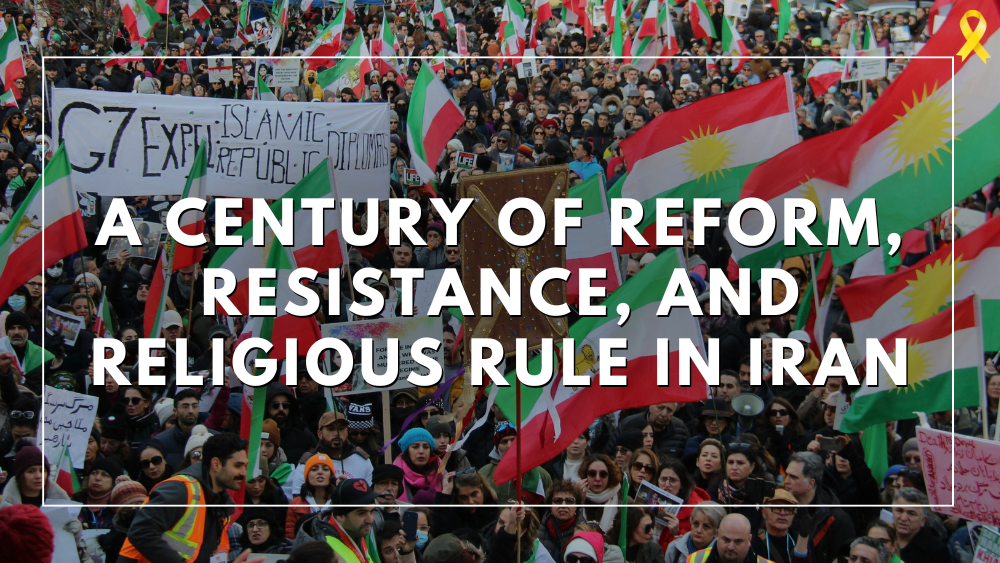
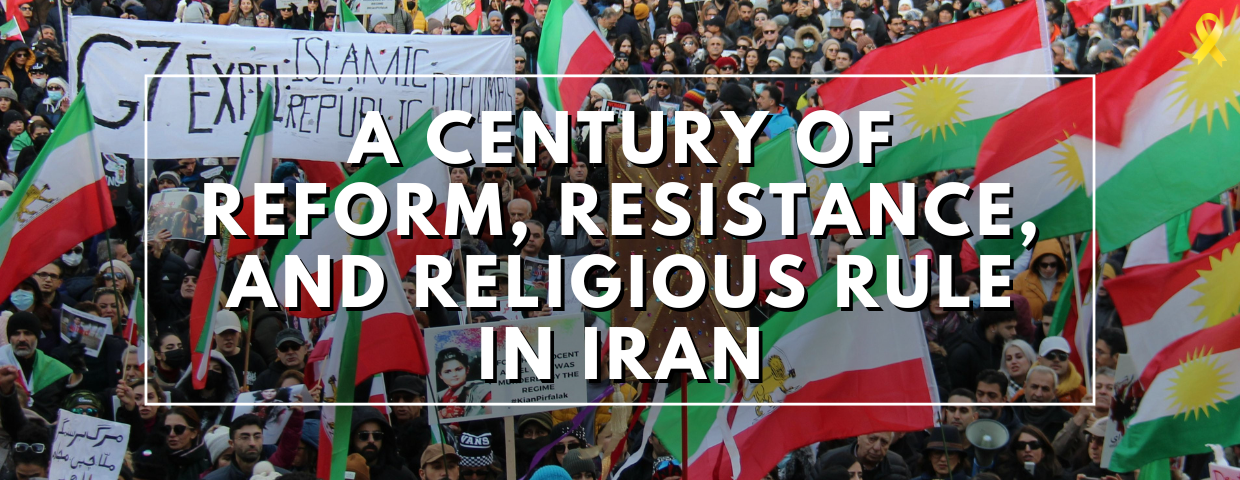
On the streets of Iran today, protests begin quietly and often end in blood. Demonstrators gather demanding change, only to be met by security forces firing live ammunition. Phones go dark as internet access is cut. Thousands are arrested. Some disappear into detention centers; others are brought before revolutionary courts, forced to confess, and executed. What unfolds is not treated as political dissent, but as defiance of religious authority itself.
These measures are enforced by a system in which clerical power overrides civil law. Courts, security forces, and morality police operate not to mediate public will, but to enforce ideological obedience. Speech, protest, dress, and personal conduct are regulated as matters of religious compliance. When large segments of society challenge that order, the state responds not with reform or representation, but with repression, violence, and death.
This reality did not emerge suddenly. It is the result of a profound transformation, how a country once governed through civic institutions and national law was reorganized into a system of religious rule, reshaping Iranian society from the ground up.
In the early decades of the twentieth century, Iran was attempting something rare in the region: to remake itself through law rather than force. In 1906, a constitutional revolution produced a parliament and a written framework meant to restrain royal authority. For the first time, governance was publicly debated, and civic institutions, however fragile, began to take shape.
That effort accelerated in the 1920s and 1930s under military leader Reza Shah Pahlavi, who became Shah (King). Power was centralized, but it was centralized through institutions. Ministries expanded, secular courts replaced religious adjudication in state affairs, and education was standardized nationwide. Railways cut across the country. Universities opened their doors. A professional civil service emerged. Persian nationalism was promoted not as a religious identity, but as a civic one, intended to bind a diverse population to the state itself. Political participation remained constrained, but the machinery of governance functioned predictably and uniformly.
For minorities, this shift mattered. Public life was no longer organized primarily around religious hierarchy. Communities long present in Iran, Jewish, Christian, Zoroastrian, and others, operated openly within the expanding economy and state system. Jewish life in Iran, rooted in a presence stretching back to the Babylonian exile, moved increasingly into the professional and urban sphere. Jews worked as merchants, physicians, manufacturers, financiers, and administrators. They served in the military and the civil service. Persian was their daily language, and Iranian culture their reference point, even as religious and literary traditions were maintained.
By the middle of the century, between 80,000 and 100,000 Jews lived across Iran, concentrated in cities like Tehran, Isfahan, and Shiraz. Their place in society reflected a broader moment in which citizenship was shaped more by law and participation than by creed.
After World War II, the pace of change quickened. Under Reza’s son, Mohammad Reza Pahlavi, oil revenues transformed the country. Cities expanded. Industries grew. Hospitals and universities multiplied. Women entered public life in unprecedented numbers. By the 1960s and 1970s, women were studying medicine, law, engineering, and the humanities; working as professors, journalists, and civil servants; shaping cultural and intellectual life. Tehran reflected global currents in cinema, fashion, music, and art. Urban Iran, uneven and imperfect, was outward-looking and socially dynamic.
Yet political power remained tightly held. Opposition was constrained. Security services expanded. Economic growth favored those closest to the state, while rapid social change unsettled religious and rural communities. By the late 1970s, inflation, corruption, and repression had eroded confidence in the monarchy. The state appeared modern, but increasingly brittle.
When protests came, they came from everywhere at once. Clerics, bazaar merchants, leftist groups, students, and intellectuals stood together in opposition, united by rejection of the Shah rather than agreement on what should follow. The collapse came faster than reform could.
The revolution of 1979 did not simply change rulers. It reordered the state. Authority moved away from national institutions and into a clerical hierarchy. Under the leadership of Ruhollah Khomeini, and later Ali Khamenei, ultimate power was vested in senior Shi‘a jurists, with the Supreme Leader (Ayatollahs) exercising control over government, courts, and the security apparatus. Law ceased to be civic. Governance was justified through religious doctrine, and compliance became a moral obligation enforced by the state.
The effects were immediate. Women were pushed out of public spaces through compulsory dress codes and professional restrictions. Universities and cultural institutions were purged and restructured. Media and education were brought under ideological supervision. Dissent was no longer treated as opposition, but as a challenge to divine authority.
Minority life contracted. Jewish communities were not expelled, but suspicion replaced participation. Businesses were seized or pressured. Travel narrowed. Public expression became dangerous. Within a decade, more than 75% of Iran’s Jewish population had left, not through a single decree, but through accumulated exclusion. Those who stayed learned to disappear into private life.
As the Islamic Republic consolidated itself, surveillance deepened. Courts became instruments of discipline. Protest was criminalized. Culture survived quietly beneath the surface, while the distance between state and society widened.
Abroad, confrontation replaced legitimacy. Resources flowed into proxy forces across the region while domestic conditions worsened. At home, sanctions, corruption, and mismanagement hollowed out the middle class. Protests erupted again and again, contained, suppressed, but never resolved.
By late 2025, long-standing pressures converged into the most significant nationwide unrest since the early years of the Islamic Republic. A prolonged economic crisis, marked by record inflation, a sharply devalued rial, rising food prices, and declining purchasing power, collided with accumulated political frustration. According to reporting from inside Iran and international monitoring groups, what began with coordinated shop closures in Tehran’s Grand Bazaar, the centuries-old commercial center that has historically signaled broader social unrest, quickly spread to cities and provincial towns across the country. University students, industrial workers, professionals, and small business owners joined demonstrations that moved beyond economic grievances to explicit demands for systemic change.
The state’s response followed a familiar but intensified pattern. Internet and telecommunications were disrupted to limit coordination and reporting. Security forces deployed live ammunition against demonstrators. Thousands were detained in sweeping arrests targeting protesters, journalists, students, labor organizers, and civil society figures. Revolutionary courts accelerated proceedings, relying on coerced confessions and vague national security charges. Executions were carried out under religiously framed accusations, as authorities characterized the unrest as externally instigated sabotage while expanding surveillance and repression.
What remains is not a resolved outcome, but an open question with real consequences. Iran’s history records periods in which civic law, institutional governance, and cultural vitality shaped public life, even amid constraint. If the current reign of repression hardens further, those foundations risk being permanently dismantled, replaced by a state sustained solely through fear, isolation, and coercion. Whether Iran hardens further under state terror or reclaims civic life will determine not only the fate of its people, but whether the country’s historic courage, creativity, and continuity can survive at all.