
By Karen Kruger
There is something extraordinary about Yom Kippur in Israel.
Yom Kippur, the Day of Atonement, is the most solemn day on the Jewish calendar. God appointed this day in Leviticus 16 and 23 as a day for the people of Israel to humble themselves before Him. In the days of the Temple, it was the one day each year when the high priest entered the Holy of Holies to make atonement for the people. Today, Jewish people throughout Israel and around the world observe Yom Kippur with fasting, prayer, confession, and repentance. It is a day when we are reminded of the seriousness of sin, our need for forgiveness, and our need to return to God.
As the sun begins to sink, the country grows quiet. The activity that characterized the days before Rosh Hashanah has ceased, and there is a sense that the entire country is slowing down. The busyness of everyday life begins to give way to the sacredness of the day. Cars disappear from the roads, shops close, and streets that only hours before were filled with traffic become almost completely still. Children ride bicycles along empty roads, while people gather in synagogues, community centers, and homes throughout the country.
Soon, we will hear the prayer of Kol Nidre, meaning “All Vows.” For generations, Jewish communities have gathered on this night to hear these familiar and solemn words. They bring us into a day that asks difficult questions about what we have said, what we have done, where we have failed, and where we need to change. Most importantly, Yom Kippur causes us to consider where we stand before God.
In Israel, these questions are not only personal because Yom Kippur is also a time of collective repentance. There is a strong sense of the collective “we.” We ask these questions as individuals, but we also understand that we belong to a people who come before God together in repentance. We consider who God has called us to be, where we have failed Him, and how we can return to Him.
Israel also carries a painful national memory connected to Yom Kippur. On Yom Kippur in 1973, when much of the country was fasting and praying, Israel was attacked by Egypt and Syria. The surprise attack began a war that would cost thousands of Israeli lives and leave a lasting mark on the country. The Yom Kippur War became a painful reminder that military strength and preparedness cannot guarantee our security.
More than five decades later, Israelis carry the additional memory of October 7, 2023, which took place on Shemini Atzeret and Simchat Torah, another of God's appointed times. Nearly three years later, the loss, sacrifice, and consequences of that day remain part of life in Israel.
These experiences remind us of something that Yom Kippur has always confronted us with, which is that our strength has limits. Israel must be strong, and we must defend our people, protect our communities, and confront those who seek our destruction. Yet there are things that military strength cannot accomplish. An army can defend a border, but it cannot reconcile us to God. Intelligence can warn us about an enemy, but it cannot expose everything within our own hearts. National strength can help preserve a country, but it cannot provide atonement for sin.
Yom Kippur brings us before the God of Israel with humility. Some worshippers dress in white, and some men wear a kittel, a white garment associated with purity and also with our mortality. We fast, set aside many of the normal comforts of daily life, and confess our sins. We acknowledge that no matter how capable or strong we may believe ourselves to be, we remain completely dependent upon God. This humility is not weakness, but rather an acknowledgment of the truth of who we are before a holy God.
This is also where the meaning of teshuvah, or repentance and return, becomes so important. Teshuvah is not simply feeling sorry for what we have done. It means recognizing that we have gone in the wrong direction, turning around, and returning to God.
The idea of return carries a special meaning here in Israel because the story of modern Israel is itself filled with physical return. For centuries, the Jewish people prayed, “Next year in Jerusalem.” After generations of dispersion, Jewish people have returned from countries throughout the world to the Land of our forefathers.
Yet physical return to the Land is not the same as spiritual return to God. We can live in Jerusalem and still be far from Him. We can rebuild ancient cities, speak Hebrew, celebrate the biblical appointed times, and defend the Land while still needing to ask whether we have truly returned to the God of Israel. Yom Kippur causes us to confront that question.
One of the most meaningful aspects of Yom Kippur is that the traditional confession is written in the plural. We confess together because we understand that sin is not merely something that exists somewhere outside of us. Each of us must examine our own heart before God while also understanding our responsibility toward one another.
Repentance cannot end with words. If we have wronged someone, we should seek to make it right. If we have allowed anger or bitterness to control us, we need to confront it. If we have become divided, we should consider how we speak to and treat one another. If we have wandered from God, we need to return to Him.
Yom Kippur also raises an even deeper question about how sinful people can truly return to a holy God. In the days of the Temple, Yom Kippur was centered on sacrifice and atonement. The high priest entered the Holy of Holies with blood, first for his own sin and then for the sins of the people. The message was clear that sin is serious and that reconciliation with God requires atonement.
Today, there is no Temple standing in Jerusalem and no sacrifice being offered on Yom Kippur. Jewish people around the world fast, pray, confess, and ask God for forgiveness. For those of us who believe in Yeshua, this day carries an even deeper significance because we believe that God Himself has provided the atonement that we could never provide for ourselves.
Our hope is not in the sincerity of our fasting, the number of prayers we pray, or our ability to become better people during the coming year. Our hope is in the mercy of the God of Israel and in the provision He made through His Son, Yeshua the Messiah, who gave Himself as the eternal offering for sin and made the way for us to truly return to God. This does not make repentance less important. Rather, it makes true repentance possible because we know where our forgiveness and reconciliation come from.
There is something sacred about the quiet of Yom Kippur in Israel. The normal noise stops, the roads become empty, and for one day, much of the country pauses. That quiet gives us an opportunity to consider where we stand before God.
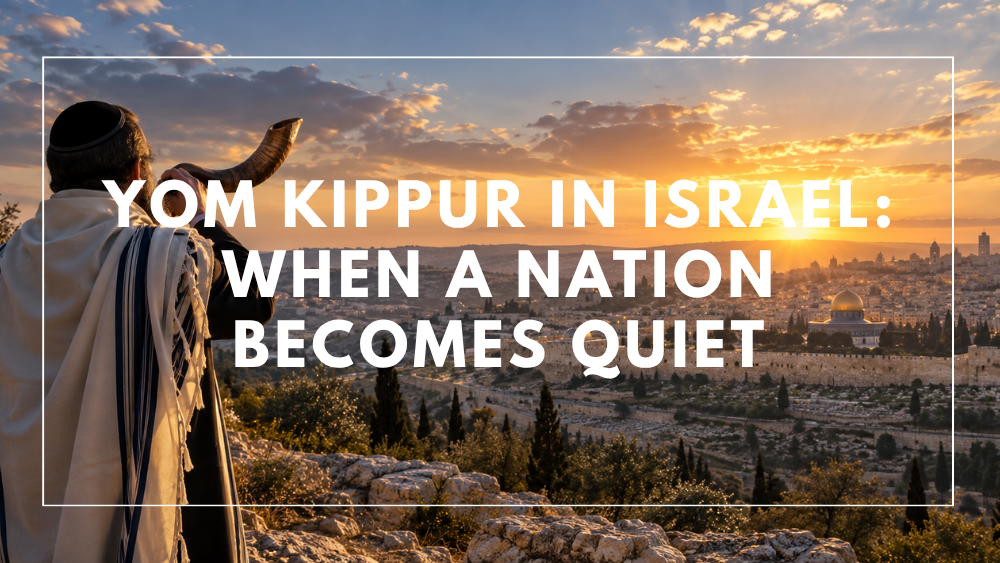
At the end of the long day of fasting and prayer, the final service begins. Our bodies are tired and our throats are dry, but people remain together until the end. Avinu Malkeinu, meaning “Our Father, our King,” is prayed as the final moments of the day approach. The shofar eventually sounds, marking the conclusion of Yom Kippur.
Soon afterward, cars return to the roads, cellphones begin ringing again, restaurants and shops reopen, and the noise of ordinary life slowly returns. However, the real question is what happens after the quiet ends. We must ask ourselves whether we simply return to life as it was or whether we have truly returned to God.
As Yom Kippur comes to an end, we greet one another with Chatimah Tovah, expressing the hope of being sealed for good in the Book of Life. Yet as followers of Yeshua, we know that our confidence before God does not rest in what we have accomplished during this day. It rests in what He has provided for us.
As Israel observes Yom Kippur after years that have brought war, loss, sacrifice, and tremendous challenges, we are reminded again that our greatest need is not simply for another year of life, but to be reconciled to the One who gives life. The God of Israel has not changed. He is faithful to His Word and to His people, and through Yeshua the Messiah, He has provided the atonement that allows us to truly return to Him.
When the shofar sounds and the quiet eventually gives way once again to the noise of everyday life, my prayer is that what happened in our hearts during those hours will not disappear with it. May we truly return to the God of Israel.