
By HFI staff
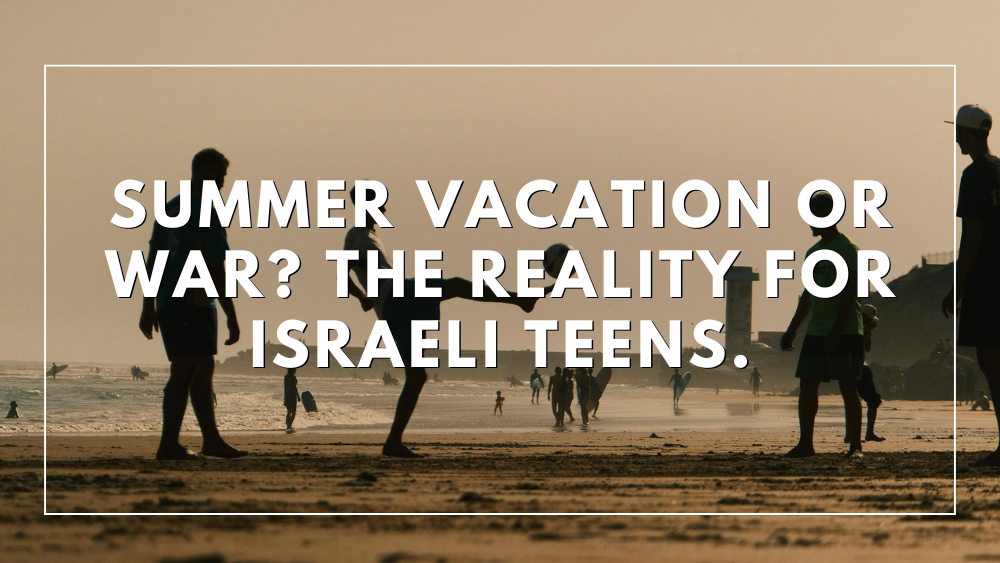
For most teenagers around the world, summer vacation is a predictable ritual of sleeping in, hanging out at the beach, working a part-time job, family holidays abroad and escaping the stress of the school year. Even when young people around the world think back to difficult periods, many remember temporary disruptions such as the COVID lockdowns, when routines were suddenly interrupted and normal teenage life was put on hold.
For teenagers in Israel, however, disruption has not been a single chapter, but a reality they have been living with for over six years. Stripped of ordinary structure, the summer months amplify a jarring contrast between the universal desire for carefree youth and the exhausting reality of growing up in a country repeatedly pulled into conflict. The past several years have been marked by uncertainty, fear, loss, anxiety, and the constant possibility that normal life may stop without warning. Even adults in Israel often struggle to make sense of this reality. A family can return to routine, rebuild plans, and begin to breathe again, only for another round of fighting to begin. Life repeatedly pauses, resumes, and pauses again. If this is confusing and exhausting for adults, it is all the more destabilizing for teenagers, who are still trying to grow, form identity, build friendships, and imagine their future.
Adolescence is supposed to be a season of both physical and mental freedom. It is the age when teens begin to move more independently, test boundaries, dream beyond their immediate surroundings, and experience the world with a growing sense of possibility. But for Israeli teens, that freedom is often accompanied by instability. Going to the mall, taking a bus, visiting a friend, attending a youth activity, or spending a day at the beach can all be shaped by the same silent calculation: Where is the nearest shelter? How much warning time will I have? Is it safe to go? Will plans be canceled again?
This summer, that uncertainty has been intensified by the disruption of the school year. The direct escalation between Israel and Iran brought daily life to a halt for five weeks, closing schools and youth centers across the country and forcing students back onto Zoom or leaving them without a stable educational framework at all. For teenagers, this meant more than missed lessons; it meant another rupture in routine, another period of isolation, and another reminder that ordinary life can disappear overnight. During the height of the escalation, cities like Tel Aviv experienced over a hundred sirens, many in the middle of the night, severely disrupting sleep and leaving teens physically and emotionally drained. The strain was serious enough that the Israeli government allocated over NIS 1.1 billion for extended summer education and academic catch-up programs to help address the educational and emotional gaps left by the shutdowns.
The deeper strain beneath the surface is clearly mapped out in Seeing Our Youth 2026, a national wartime study surveying 2,122 young Israelis in grades 7 through 12 across all regions of Israel. The data reveals a generation holding it together, but at a personal cost. While 88.6% of these teenagers score exceptionally high on prosocial values and care for others, nearly half are completely energy-depleted. Only 55.6% report feeling energetic and vital, and just 47.1% are able to maintain focus under pressure.
These mental and physical challenges are made even harder by the fact that many adolescents do not feel fully anchored within the support systems around them. The survey suggests that students are looking for a deeper sense of care, connection, and personal attention in their daily environments. Many expressed that their emotional well-being is not always noticed in school settings, pointing to a broader need for spaces where teenagers feel genuinely seen, heard, and supported.
New research from communities in Israel shows how deeply children and teenagers are being affected by prolonged exposure to rocket fire, sirens, evacuations, and explosions. Among school-aged children and teens, researchers have found emotional difficulties, concentration problems, and signs of chronic anxiety. In southern communities, group therapy programs have revealed an urgent need for deeper trauma processing, with many students requiring more intensive clinical intervention.
Taken together, these findings make the emotional consequences of this ongoing reality impossible to ignore. Israel’s children and adolescents did not choose this war, yet they are carrying much of its weight. Recent reports show that even before the latest escalation, nearly one in three Israeli youth were already considered at risk. Since the beginning of the current war, tens of thousands of children and teens have been recognized as physically or mentally harmed, thousands were evacuated from their homes, and many have lost parents or loved ones to terrorism or military service. Mental health professionals are now warning that this is not only a period of stress, but a generational crisis, with PTSD, depression, anxiety, and calls to emergency mental health hotlines rising sharply. For at-risk youth, the burden is even heavier, as new trauma was layered onto existing instability while displacement and school closures removed the routines and safe spaces that once helped them stay grounded.
Yet Israeli teenagers are not only looking for support, but also for ways to respond to this reality with purpose. They want opportunities to contribute, be heard, and take part in what is happening around them in a constructive way, even as the adults and frameworks around them often try to protect them from additional stress or responsibility. Seeing Our Youth 2026 data shows that teens involved in both formal frameworks, like student councils, and informal frameworks, like youth movements, report far higher levels of energy, motivation, well-being, and civic engagement than those who are unaffiliated. These spaces give exhausted teens a sense of structure, belonging, and purpose, helping them fight burnout, feel more in control, and reclaim a piece of their youth even amid the instability of war.
It is precisely in the places where teenagers need a sense of belonging, support, and purpose that we thank God for the privilege we have at Hope for Israel to serve and encourage young people through the Neryah believing youth group. Teenagers from various congregations in Jerusalem and the surrounding area participate in the group. As part of our ministry, we hold weekly meetings divided by age groups: grades 9–10 and grades 11–12. During these gatherings, we share words of encouragement, talk about the challenges and struggles they face in their daily lives, pray together, celebrate holidays and special occasions, and create a safe space for them. As part of our ongoing commitment to walk alongside them throughout their teenage years, we also visit them in their schools and neighborhoods. Over the years, and especially during the challenging period of recent years, we have witnessed the significant impact this group has had on the lives of many young people and the importance of providing a place that offers stability, hope, and a sense of belonging amid an uncertain reality.
As Israel’s teenagers continue to grow up under the weight of uncertainty, fear, and repeated disruptions after years of war, we invite you to join us at Hope for Israel in praying for the youth of Israel. Pray that the years of conflict they have endured will not define their future; that they will be protected physically and emotionally, surrounded by caring adults and safe communities, strengthened with courage, and given the freedom to heal, to hope, and to experience the fullness of their youth under God’s peace and His vision for their lives.
If you would like to stand with us in shaping the next generation of Israel, we invite you to partner with Hope for Israel. Through the Neryah believing youth group and other next generation initiatives, we have the privilege of walking alongside young people during some of the most formative and challenging years of their lives. Your partnership helps provide a place where teenagers can find encouragement, meaningful relationships, biblical guidance, and a sense of belonging in the midst of an uncertain reality.
Together, we can continue investing in the lives of young Israeli believers, helping them grow in faith, character, and hope as they prepare to become the leaders, parents, and citizens of tomorrow. Thank you for considering how you can be part of this important work through your prayers and support.