Hanukkah is often remembered as the story of a small jar of oil that burned for eight days. Yet at its foundation, the holiday marks something deeper: the Jewish struggle to defend identity, truth, and faith in the face of coercive power. Hanukkah recalls a moment in history when a dominant empire sought to redefine Jewish life, and a small community refused to surrender who they were.
In the second century BCE, Judea came under the control of the Seleucid Empire, a Hellenistic Greek kingdom that emerged after the death of Alexander the Great. Under the rule of King Antiochus IV Epiphanes, severe decrees were imposed that curtailed Jewish religious practice. Altars to Greek gods were erected in Judean towns, the Temple in Jerusalem was repurposed for pagan sacrifice, and possession of Torah scrolls became a punishable offense. Public Torah study, circumcision, Sabbath observance, and Temple worship were restricted or banned. These policies aimed to reshape Judean society into the broader Hellenistic culture, erasing the distinctiveness of Jewish life. Some within the community yielded to this pressure, believing assimilation would bring security or progress.
Others refused.
Led first by Matityahu, a priest from Modi'in, and later by his son Judah the Maccabee, a small and determined group rose in resistance. They fought with limited weapons, relying on knowledge of the Judean hills and the determination of farmers and priests who had little military training. Their revolt was not merely political. It was a fight for continuity, memory, and the freedom to worship without imposed conditions. Against overwhelming odds, they stood firm, fueled by conviction rather than power.
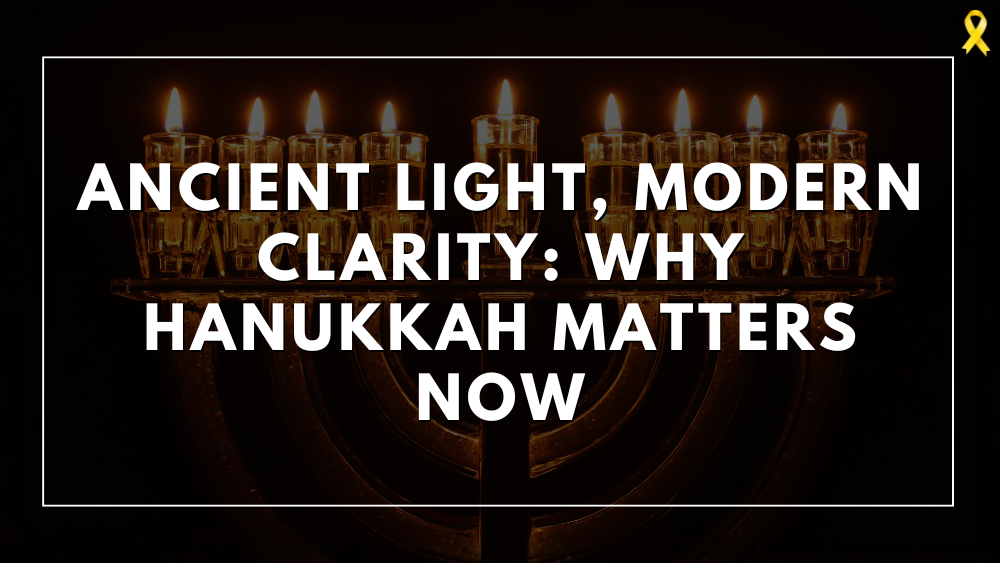
When the Maccabees reclaimed Jerusalem and rededicated the Temple, the act carried profound significance. The sanctuary had been defiled, its altar dismantled, and its sacred vessels taken; restoring it required both physical rebuilding and moral courage. Restoring Jewish worship in a place that had been desecrated was a declaration of moral and spiritual resilience. Lighting the menorah, even with only a limited supply of oil, became a visible statement of clarity and purpose. The light symbolized truth and faithfulness in a time when darkness threatened to obscure both.
The menorah is not hidden away; it is placed in visible spaces. Each night adds light, not because darkness disappears all at once, but because truth is built steadily, courageously, flame by flame. Visibility itself becomes part of the message. To light the menorah is to refuse erasure and to insist that identity, faith, and memory remain seen.
That contrast lies at the heart of Hanukkah. Light stands for truth, memory, and moral clarity. Darkness represents coercion, distortion, and the pressure to forget or remain silent. Hanukkah teaches that even a small flame can dispel great darkness, and that resilience often begins with the courage to remain visible.
Today, the meaning of Hanukkah feels unmistakably present. Israel is confronted not only with physical challenges but with moments that test its collective character, asking what must be held onto even in times of strain. Public debate is loud, information moves fast, and the pace of events can leave little room for reflection, yet these pressures make the core values of a society more visible, not less. The ancient story reminds us that societies are shaped not only by power, but by the truths they refuse to relinquish. Hanukkah’s light becomes a quiet discipline of courage, of staying rooted when the world feels unsteady, of refusing to let confusion drown out clarity. It teaches that safeguarding truth is never passive, and that speaking with conviction, even when it is difficult or unpopular, is a form of leadership in itself.
Lighting the Hanukkah candles is more than a tradition. It is a courageous commitment to truth, responsibility, and remembrance. One flame at a time, the light declares that history will not be erased, truth will not be rewritten, and identity will not be surrendered.
2 Comments on “Ancient Light, Modern Clarity: Why Hanukkah Matters Now”
Muchos Saludos
Amigos
Moran,
Thank you so much for giving us clarity on Hanukkah. I learned so much just from this short message you posted.