
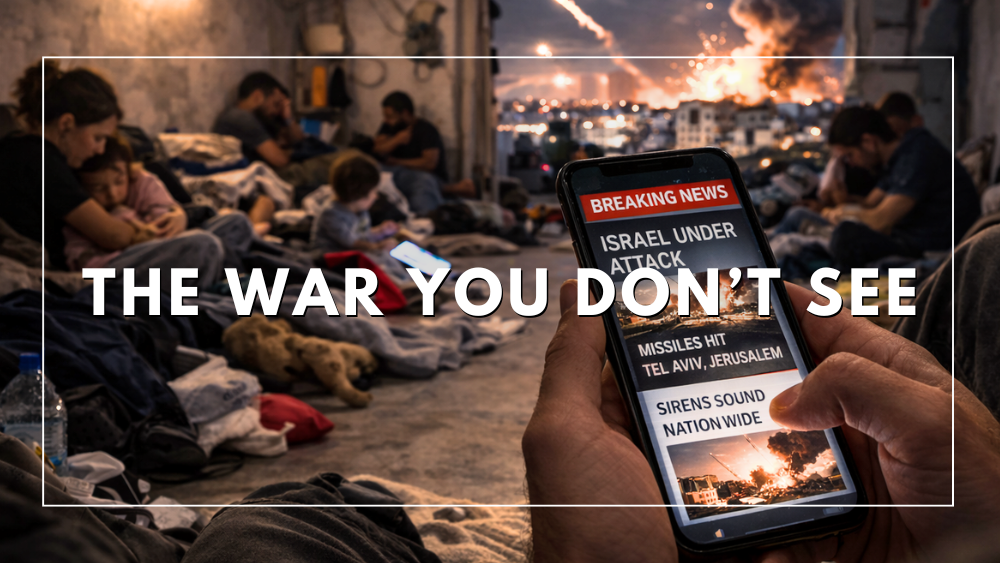
In times of war, the front lines are not only geographic. They are digital. Since the escalation with Iran and the sustained missile fire targeting Israeli cities, Israelis have been living in two parallel realities. One unfolds in the sky with sirens and interceptions. The other unfolds on screens in real time across WhatsApp groups, Instagram stories, Telegram channels, and news feeds. This war is being experienced and understood through digital platforms as much as through traditional broadcasts, and that has reshaped how the nation responds.
When sirens sound, information spreads instantly. Alerts, impact reports, and safety instructions circulate within seconds. Neighborhood groups notify residents which shelters are open. Municipalities post updates about school closures and emergency protocols. Families separated by distance send brief messages that carry enormous weight. A simple “We’re safe” from inside a protected room can steady hearts across continents. In a country where seconds matter, digital communication has become an extension of civil defense.
Yet social media has become more than a practical tool. It has also become an emotional outlet in a time of sustained strain. Israelis share fear, grief, exhaustion, and determination openly. Images of neighbors gathering in shelters, volunteers delivering food to displaced families, and communities honoring those murdered in missile strikes travel quickly and widely. These posts do more than document events. They remind people that courage is collective.
This connection extends far beyond Israel’s borders. For Jews and friends of Israel abroad, social platforms have become a direct window into reality. Rather than filtered headlines, they see firsthand accounts from families, soldiers, medics, and volunteers. In response, diaspora communities mobilize prayer, advocacy, and practical support. Fundraisers for affected families spread rapidly. Calls for blood donations and emergency supplies are amplified within minutes. Digital platforms have turned concern into coordinated action.
At the same time, the online space is not neutral ground. As missiles target Israeli neighborhoods, misleading narratives spread just as quickly across digital platforms. In recent days we saw a claim circulating online repeating something commentator Tucker Carlson said, suggesting that Chabad was somehow pushing the world toward war with Iran.
Chabad is a Hasidic Jewish movement. Turning Jews into the hidden villains behind global conflicts is one of the oldest antisemitic conspiracies in history. It has led to violence before, and it must be rejected again.
Other claims circulating online are simply detached from reality. Posts have been spreading that thousands of Israelis are fleeing the country. The problem with that claim is simple. During the height of the attacks Israel’s airport was closed, and even now flights remain extremely limited. The reality most Israelis are experiencing is not people fleeing, but the opposite. Many Israelis who were abroad when the war began have been trying to return home while the country remains under attack.
What is new today is not the existence of conspiracies or false claims. These have always existed. What is new is the speed with which they now spread and the millions of people they can reach within hours.
The deeper concern is what happens when those who know the truth choose to remain silent. In the digital age, silence allows distortion to travel further and faster than truth. In that sense, the digital space has become another front in this war, shaping how events are understood far beyond Israel’s borders.
This war is being fought in two arenas. One is visible in the sky above Israel, where missiles are intercepted and sirens send families into shelters. The other unfolds quietly on screens around the world, where images, claims, and accusations travel faster than facts. What people believe about a war can shape the war itself.
In response, many Israelis have become reluctant but necessary digital ambassadors. Civilians document what they witness. Journalists verify and contextualize footage. Ordinary users counter falsehoods with facts and lived experience. The responsibility is heavy, but it reflects an understanding that perception influences policy and solidarity.
Amid this tension, something deeper has emerged. Social media has strengthened national solidarity in ways that feel immediate and personal. When a missile strikes in Tel Aviv or Beit Shemesh, the images are seen within moments in Haifa, Eilat, and Jerusalem. Grief becomes shared. Encouragement becomes visible. Soldiers receive messages from strangers thanking them for standing guard. Families of reservists find support from across the country. In previous generations, unity gathered in public squares. Today, it gathers in group chats and comment threads.
None of this replaces physical protection or strategic defense. Social media cannot intercept missiles or neutralize threats. However, it has become part of how Israel endures. It connects neighbors, mobilizes aid, counters disinformation, and sustains morale. It ensures that even when families are confined to shelters and daily life is disrupted, the sense of shared purpose remains strong.
War tests the courage of institutions, infrastructure, and spirit. It also reveals the strength of a nation’s networks. In this moment, one of Israel’s most powerful networks exists in the digital space where information moves quickly, solidarity travels far, and connection persists despite uncertainty.
At Hope for Israel, part of our calling is to present the reality on the ground with honesty and clarity. By sharing verified updates, personal testimonies, and the stories of those living through these events, we seek to provide a trustworthy voice amid the noise. This work is not about winning arguments online. It is about helping people understand what is truly happening, correcting misinformation, and ensuring that truth is not overshadowed by distortion. Reliable voices matter in moments like these, because truth brings clarity where confusion spreads quickly.
Even under fire, the truth still matters.
2 Comments on “The War You Don’t See”
Thank you for keeping us updated on what is really happening in Israel. Thank you for sharing with us. My and my husbands prayers are being prayed daily for your country. For your people. For your soldiers also for America and our soldiers. We love YHVH and Yeshua and Israel.
Hoping this message finds all well.
Theresa Jackson
We are praying for you all during these very hard times you’ve been going through. We cannot begin to imagine what it is to live in an active war zone and to deal with all the antisemitism from every direction. Thank you for keeping us informed to the truth of what’s going on in your homeland.